VASH Landscaping Addresses Common Questions About When Grading Work Becomes Necessary
Murfreesboro, United States – February 27, 2026 / VASH Landscaping & Hardscaping /
Homeowners Face Uncertainty About Drainage Intervention Timing
MURFREESBORO, TN — Property owners throughout Middle Tennessee regularly confront questions about when visible water movement constitutes a cosmetic nuisance versus a situation requiring intervention. VASH Landscaping & Hardscaping has released detailed information on drainage problem assessment to help homeowners evaluate severity, understand progression patterns, and make informed decisions about timing and scope of potential corrections.
The distinction between minor inconvenience and developing structural threat often appears unclear to property owners lacking technical background in grading and water management. This uncertainty leads to delayed action that compounds repair complexity or premature investment in solutions that exceed actual need.
Distinguishing Between Surface Issues and Structural Concerns
Not all water movement across a property signals immediate danger. Brief puddling during heavy rain that dissipates within hours rarely indicates serious problems. Temporary saturation in low areas after major storm events falls within expected behavior for many soil types. Occasional standing water in turf areas without accompanying erosion may reflect nothing more than compaction or thatch buildup.
However, certain patterns warrant closer evaluation. Persistent standing water that remains 24 hours or longer after rain suggests inadequate site grading or subsurface drainage limitations. Erosion channels cutting through beds, turf, or exposed soil indicate concentrated flow with sufficient velocity to displace material. Foundation dampness or basement moisture following rain events points to water moving toward rather than away from structures. Settling or sinking hardscape elements like patios, walkways, or retaining walls signal subsurface water accumulation undermining structural integrity.
The progression from minor to major drainage problems accelerates under certain conditions. Properties with clay-heavy soils, common throughout Rutherford, Williamson, and Davidson Counties, experience reduced percolation rates that concentrate surface water. Sloped lots naturally channel water downhill, and any grading imperfection creates preferential flow paths. Proximity to existing drainage features like ditches, streams, or retention ponds affects how water enters and exits a property. Roofing and hardscape additions that increase impermeable surface area concentrate runoff volumes beyond what original grading anticipated.
Homeowners frequently underestimate how quickly minor drainage annoyances evolve into expensive repair scenarios. What begins as occasional puddling becomes persistent standing water as soil compaction increases. Small erosion rills deepen into channels that undercut plantings and structures. Foundation moisture advances from surface dampness to interior water intrusion. Each rain event compounds existing problems rather than simply repeating them.
Long-Term Implications of Drainage Decisions
The choice to address or postpone drainage corrections ripples through multiple aspects of property value and usability. Landscape health suffers when plantings experience alternating waterlogging and drought stress. Root systems weaken, disease pressure increases, and specimen plants fail despite appropriate species selection and care. Hardscape longevity diminishes when water undermines base materials or creates freeze-thaw cycling beneath pavers and concrete. Settling and cracking develop that require complete reconstruction rather than simple releveling.
Foundation integrity represents the most significant long-term concern. Water pooling near structures exerts hydrostatic pressure against foundation walls. Clay soils expand when saturated and contract when dry, creating cyclical movement that stresses foundations. Moisture intrusion into basements or crawlspaces promotes mold growth, damages stored items, and undermines structural wood elements. The cost differential between preventive drainage correction and foundation repair runs into tens of thousands of dollars.
Property resale value reflects drainage condition through multiple pathways. Obvious standing water problems deter potential buyers or trigger inspection concerns that complicate closing. Home inspectors routinely flag inadequate grading, and lenders may require corrections before approving financing. Even properties without current foundation damage face buyer hesitation if drainage patterns suggest future risk.
Usability limitations constrain how homeowners enjoy outdoor spaces. Portions of yards become unusable after every rain, eliminating play areas, entertaining spaces, or garden locations. Soggy conditions extend maintenance windows, preventing mowing, planting, or other activities for days following storms. Mosquito populations thrive in standing water, creating pest problems that diminish outdoor comfort.
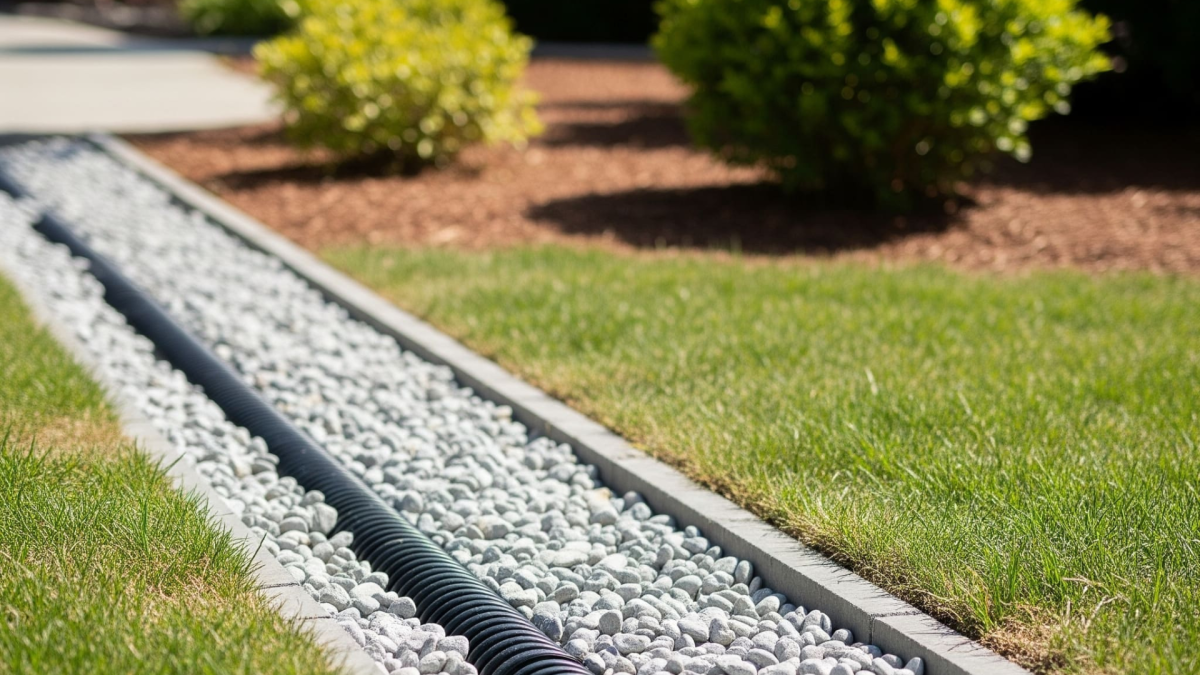
The financial analysis of drainage work timing favors early intervention in most scenarios. Small-scale corrections addressing developing problems cost substantially less than major regrading projects required once erosion has restructured site topography. Preventive French drain installation runs a fraction of the expense associated with foundation waterproofing or structural repairs. Investment in proper drainage protects rather than competes with spending on landscape and hardscape improvements.
Evaluating Drainage Problems in Real Project Context
The team at VASH Landscaping & Hardscaping approaches drainage evaluation by examining both immediate symptoms and underlying site conditions. Assessment includes walking the property during and after rain to observe actual water behavior, not theoretical flow paths. Evaluation considers how existing features like downspout discharge points, paved surfaces, and grade transitions affect water movement. Analysis accounts for soil composition and its permeability characteristics.
This examination reveals whether problems stem from correctable grading errors, require subsurface drainage solutions, or demand more comprehensive site work. Sometimes simple adjustments like extending downspouts away from foundations or installing shallow swales solve persistent issues. Other situations call for French drain systems that intercept groundwater before it reaches problem areas. Complex scenarios may necessitate comprehensive regrading that reshapes site topography to establish positive drainage throughout the property.
The company’s combined capabilities in excavation, drainage systems, grading, and landscape reconstruction allow for integrated solutions. Drainage corrections often require coordinated work across multiple disciplines. A French drain installation may need excavation followed by bed restoration and turf repair. Major regrading might involve temporary irrigation system modifications and subsequent landscape replanting. This coordination prevents the complications that arise when drainage specialists, excavators, and landscapers work independently without unified planning.
Projects prioritize solutions that address root causes rather than symptoms. Surface water problems may actually reflect subsurface water tables or concentrated runoff from upslope properties. Foundation dampness might trace to improperly graded planting beds rather than site-wide grading inadequacy. Identifying actual water sources and movement patterns ensures interventions solve rather than simply relocate problems.
Site-Specific Variables That Influence Drainage Needs
Properties throughout the Nashville service region demonstrate wide variation in drainage behavior based on specific characteristics. Lot size and shape affect how much area contributes runoff to any particular location. Existing vegetation density influences interception and evapotranspiration rates. Prior construction activity may have created compacted zones or buried debris that disrupts natural percolation. Neighborhood infrastructure like street drainage and retention systems affects water elevation during storm events.
Age of existing drainage features factors into evaluation. Properties with decades-old French drains may have experienced failure through root intrusion, sediment accumulation, or pipe deterioration. Grading that functioned adequately when homes were new may prove insufficient after landscape maturation increased canopy density and changed precipitation interception patterns. Hardscape additions like patios and driveways concentrate runoff that original site design never anticipated.
Understanding these site-specific factors helps property owners set realistic expectations about intervention scope and results. Some situations benefit from targeted repairs. Others require comprehensive redesign that reconceives site drainage entirely. The investment scales accordingly, but properly matched solutions provide lasting functionality rather than temporary improvement.
Responsive Communication and Local Knowledge
VASH Landscaping & Hardscaping maintains focus on clear explanation of observed conditions and practical solution options. Customer interaction emphasizes showing rather than telling, walking properties to demonstrate water movement patterns, and explaining how proposed interventions alter existing conditions. This approach helps homeowners understand both the technical aspects of drainage work and the reasoning behind specific recommendations.
The company serves properties across Middle Tennessee communities where local expertise informs effective drainage solutions. Regional experience with clay soil behavior, typical lot configurations, common construction practices, and local weather patterns shapes practical understanding of what works reliably over time. This knowledge base prevents generic solutions that may perform adequately elsewhere but prove inadequate for Tennessee conditions.
Project communication includes realistic timelines, transparent discussion of potential complications, coordination with other planned work, and follow-up after completion to verify performance. This consistency addresses common frustrations homeowners report with contractors who provide inadequate explanation, disappear once deposits are collected, or fail to ensure work achieves intended results.
Preventing Compounding Problems Through Early Assessment
Drainage problems exhibit exponential rather than linear progression. Minor issues left unaddressed create conditions that accelerate deterioration. Erosion removes soil that previously provided grade, worsening water concentration. Foundation moisture weakens structural elements, increasing vulnerability to next season’s water exposure. Settling hardscapes create new low points that collect additional water.
Early evaluation interrupts this progression before damage requires extensive correction. Simple interventions implemented when problems first appear prevent the need for major reconstruction later. Property owners questioning whether visible water concerns merit professional assessment generally benefit from consultation, even if evaluation concludes that immediate action isn’t necessary. Understanding current conditions and monitoring parameters provides baseline information that informs future decisions.
Homeowners with questions about specific property conditions, drainage problem evaluation, or solution options can reach VASH Landscaping & Hardscaping at 629-290-1462. The company serves properties throughout Murfreesboro, Nashville, Franklin, Brentwood, and surrounding Middle Tennessee areas.

Contact Information:
VASH Landscaping & Hardscaping
270 Glenis Dr Ste A
Murfreesboro, TN 37129
United States
Contact VASH Landscaping & Hardscaping
(629) 290-1462
https://vashlandscaping.com/

Original Source: https://vashlandscaping.com/media-room/


