
Key Takeaways
- Short, frequent watercolor sessions build brushwork and water control faster than occasional long painting marathons
- Pre-sketched workbooks help beginners skip the blank-page freeze and start painting within minutes
- Targeted exercises like painting small, mixing three-color swatches, and practicing individual facial features speed up skill growth
- A closer look at common beginner mistakes shows why fixing water ratios and paint order matters more than buying fancier supplies
- Tobio’s Kits says that simple habits, including picking a reference photo the night before and learning how dry time works, keep practice sessions focused – find more of their expert insights below
Watercolor painting rewards patience more than natural talent. Beginners who improve quickly usually share one habit: they practice in short, structured bursts instead of waiting for a rare free afternoon.
This guide breaks down why frequent short sessions work, which exercises build real skill fastest, and how guided workbooks and targeted practice tips can help beginners avoid the most common early frustrations.
Why Frequent Short Sessions Win
Most beginners assume that more time at the easel automatically means more improvement. Watercolor skill, though, depends on repetition more than duration. Water control and brushwork are physical habits, and physical habits get trained through frequent practice, not occasional long stretches of it.
A ten-minute session done four times a week trains the hand and eye more effectively than one two-hour session squeezed in every other weekend. Each short sitting forces a fresh round of decisions: how much water to load, how fast the paper is drying, how a color shifts once it hits the page. Those decisions, repeated often, become instinct. Painters who stretch practice into rare, marathon sessions tend to relearn the same lessons each time instead of building on them.
The obstacle for most beginners? A lack of momentum, not a lack of skill. Sitting down to a blank sheet with no plan wastes the first several minutes of a session on hesitation, which happens to be when focus and motivation are at their highest. Removing that friction, whether through a pre-sketched page or a reference photo chosen the night before, changes how much of each session actually goes toward painting rather than deciding what to paint.
4 Tips for Productive Practice
Good practice habits matter as much as good technique. The following four tips keep sessions efficient so more of the available time goes toward painting instead of setup, searching, or second-guessing.
Paint Small & Often
Painting small is arguably the single most impactful habit a beginner can build. A small painting forces composition, color mixing, drawing, and timing to happen all at once, in miniature, which means more repetitions fit into the same amount of time.
- Small paintings take less time to finish, so they actually get finished rather than abandoned halfway.
- Reducing the size of the paper also reduces the pressure of ruining a large piece, which encourages more experimentation.
- Three to five small studies can be completed in the time one large painting takes, multiplying the number of lessons learned per session.
- Repetition at a small scale builds muscle memory for brushwork and water control faster than fewer, larger attempts.
Timing matters especially in watercolor, since every stroke is a race against the drying clock. Painting small teaches quick decision-making and trust in instinct, a skill that pays off later when scaling up to bigger, more ambitious pieces.
Pick Your Reference the Night Before
One of the most common time-wasters in a practice session is spending the first twenty minutes scrolling through photos looking for something to paint. Deciding the night before solves this instantly; the brush should be in hand within two minutes of sitting down.
A reference photo works as a visual blueprint, offering structure for shape, color, and detail rather than a rulebook to follow exactly. Treating it as a guide rather than a standard to match leaves room to simplify or adjust the composition. Choosing the reference ahead of time also gives the brain a chance to pre-visualize the painting, from color choices to the direction of light, which makes the actual session more focused once the brush touches paper.
Understand Dry Time
Watercolor is defined by water, and water evaporates on its own schedule. Depending on paint thickness, water content, humidity, and paper quality, a wash can dry anywhere from a few minutes to half an hour, which leaves a limited window to blend edges or drop in a second color before the moment passes.
Working into paint that has already dried creates crisp, hard edges. Working into paint that is still wet creates soft, flowing blooms. Neither result counts as a mistake, but knowing which effect is happening, and why, turns dry time from a source of frustration into a tool. A hairdryer set to low and cool, held six to eight inches from the page and kept moving, can speed up drying without warping the paper.
To check if a layer is fully dry before adding another, look for a dull, matte finish, or gently run a dry brush over the area and press it against a paper towel to see if any color transfers.
Paint What You Love When Stuck
Every watercolor painter hits sessions where nothing feels right, the colors turn muddy, the edges land wrong, and the whole piece looks stiff. When that happens, pushing through a difficult subject rarely helps. Switching to something genuinely enjoyable resets the connection to the medium.
A simple cup of coffee, a flower from the garden, or the view from a window all make low-stakes subjects. They allow technique to keep developing without the added weight of expectation, and they often bring back the enthusiasm that got someone started with watercolor in the first place.
4 Exercises to Build Skill Fast
Beyond good habits, a handful of specific exercises accelerate skill-building by targeting exactly what beginners struggle with most: control, color, and confidence with the brush.
Paint With Zero Plan
Five minutes of unplanned painting at the start of a session works like a warm-up. Loading a brush with whatever color feels right and moving it across wet paper, without any goal in mind, reconnects the hand and eye after time away from the page.
Removing the pressure of an outcome opens space to actually notice what the paint is doing: how it pools, how it spreads, how a second color dropped into a wet area blooms outward in unpredictable ways. These small observations become the raw material for real technique later on.
Color Play Over Perfection
Choosing three or four pigments that do not obviously match, then layering them in stripes, swirls, or overlapping washes, builds an intuitive sense of how specific paints behave together. Some combinations turn muddy, some granulate in interesting ways, and some stay vibrant no matter how they overlap.
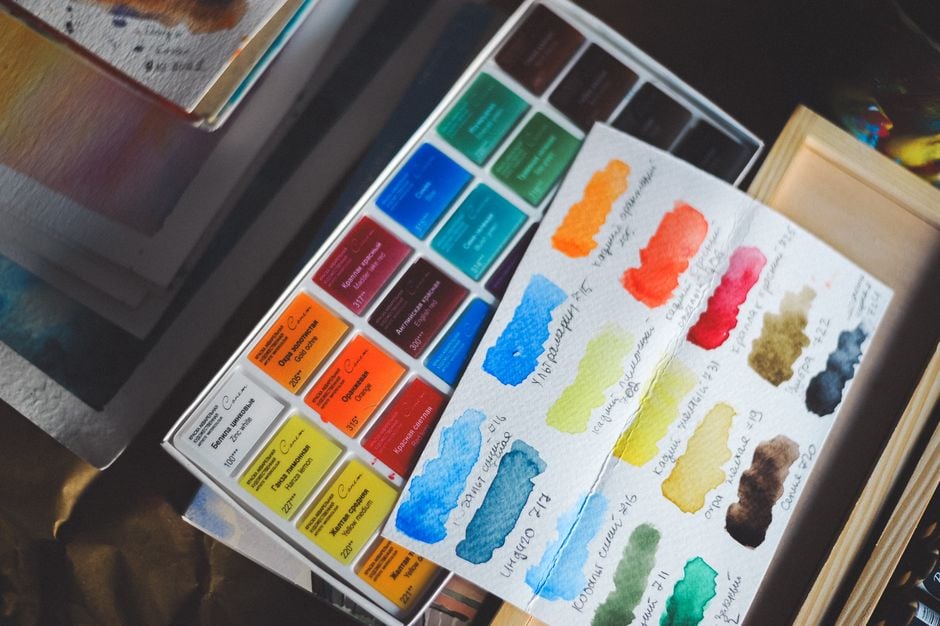
Every brand and every pigment reacts differently, and the only way to learn a given set is through deliberate experimentation. Keeping a small notebook of these color swatches builds a personal reference library that grows more useful with every session.
Practice People With Simple Shapes
Painting people intimidates many beginners because watercolor leaves little room to overwork a passage before skin tones turn muddy. The fix is to isolate the pieces first, practicing individual facial features or simple figure shapes until each feels familiar on its own.
Focusing on movement and silhouette before chasing likeness produces more compelling results than a stiff, technically precise figure. Watercolor’s soft edges and flowing washes suit the human form well once the instinct to overwork it is set aside. Quick two-minute studies from life, sketched at a coffee shop or on public transit, build the visual vocabulary needed for more convincing figure work later.
Common Beginner Mistakes to Avoid
Certain mistakes show up again and again among beginners, and most trace back to a handful of fixable habits rather than a lack of natural ability.
- Using too little water is one of the most frequent errors, since watercolor depends on generous water-to-pigment ratios for the fluid washes the medium is known for.
- Painting on regular paper instead of dedicated watercolor paper leads to buckling, pilling, and colors that never look quite right.
- Working dark-to-light instead of light-to-dark causes trouble because watercolor relies on the white of the paper for its lightest tones; once a light area is covered with dark paint, it is difficult to recover.
- Applying new paint to a layer that is damp but not fully dry, and not wet enough to blend cleanly, tends to produce muddy colors instead of crisp edges or soft blooms.
- Overworking a painting with too many layers or excessive fussing over small details causes it to lose the freshness and luminosity that make watercolor distinct.
Avoiding these pitfalls doesn’t require new supplies or advanced technique. It mostly calls for slowing down long enough to plan light areas before starting, letting layers dry fully between passes, and resisting the urge to keep adding detail after a painting already looks finished.
Practice Habits Determine Progress, Not Talent
Watercolor skill grows through habits, not luck. Short sessions, targeted exercises, and a workbook that removes the blank-page freeze turn practice into something predictable and repeatable, rather than a hobby that stalls after a few tries. In the eyes of Tobio’s Kits, beginners who stick with a simple, consistent routine tend to see visible progress within weeks rather than months.
None of the techniques covered here require rare talent or expensive materials. They require showing up often, in small doses, with a clear plan for what to paint and a basic understanding of how water behaves on the page. For anyone ready to put these habits into practice without the extra step of sourcing separate supplies, you might consider an all-in-one watercolor starter kit to make that first brushstroke less intimidating.
Tobio’s Kits
info@tobioshop.com
+1 (305) 257-6512
3833 Powerline Road
Ste 201
Fort Lauderdale
Florida
33309
United States


