
Key Takeaways
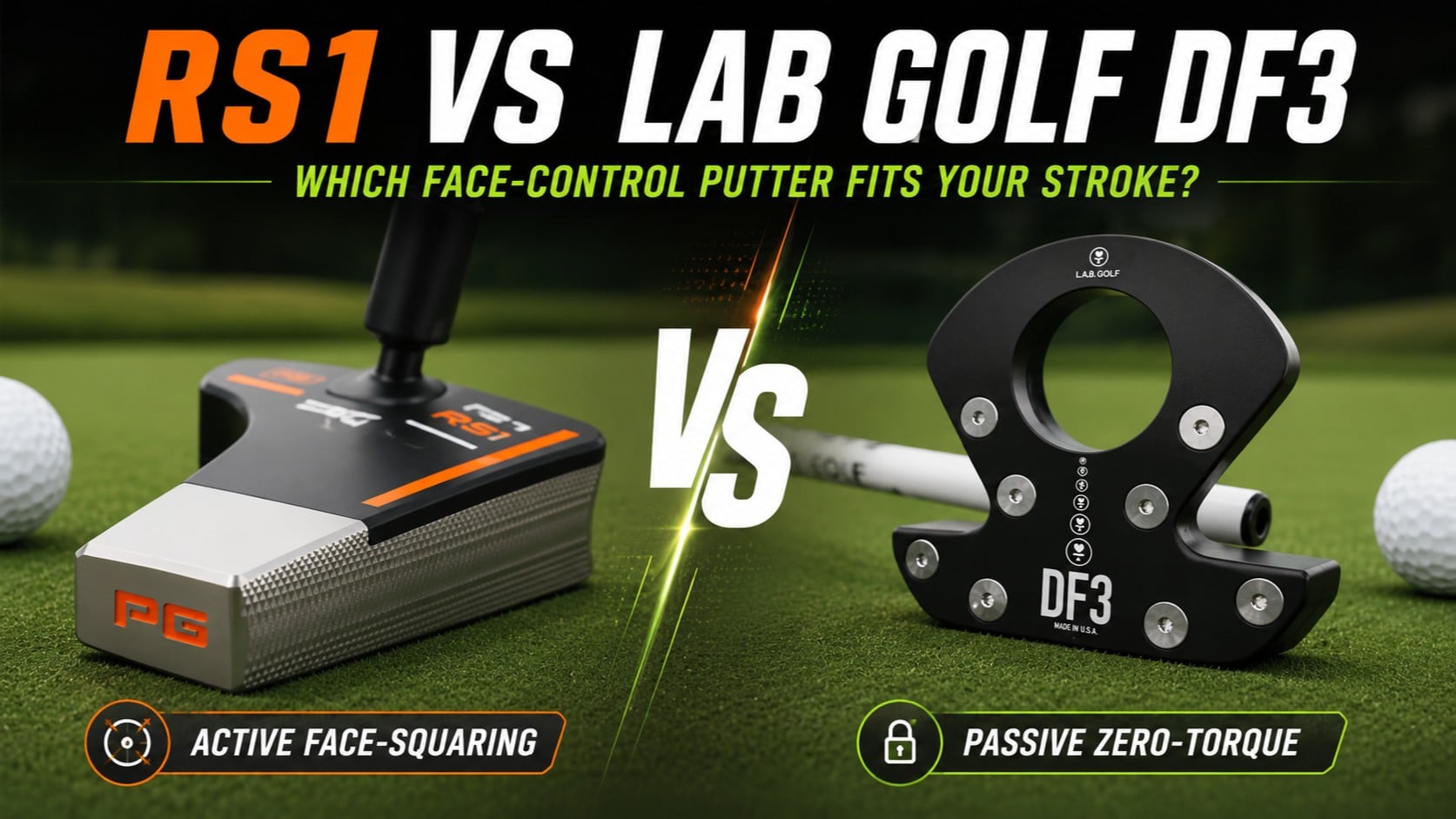
- The Performance Golf RS1 actively pulls the putter face toward square using Forward Axis Weighting, while the LAB Golf DF3 uses zero-torque Lie Angle Balancing to keep the face passively neutral
- This comparison looks at both putters’ technology, pricing, and return policies side by side to help golfers match the right design to their stroke
- The RS1 starts at $399 with a 365-day money-back guarantee, while the DF3 typically runs from $600 to $800 or more once fitting is factored in
- Golfers with a consistent directional miss pattern tend to benefit most from active correction, while golfers with elite, well-grooved strokes may prefer passive neutrality
- Feel, sound, aesthetics, and moment of inertia also factor into choosing between these two face-squaring philosophies
Anyone shopping for a face-control putter eventually runs into the same two names: the Performance Golf RS1 and the LAB Golf DF3. Both are built around the same core problem in putting, and both claim to solve it while taking almost opposite roads to get there.
Two Putters, One Problem: Face Angle at Impact
Face angle at impact is one of the biggest factors in whether a putt starts on line. Even small errors matter a lot. A putter face that is 2 degrees open at impact will miss the hole from 5 feet, and for a putt to go in at 8 feet, the angle of the face needs to be less than 1 degree open or closed to the target. That is a tiny window, and it explains why so much putter engineering now centers on keeping the face square rather than on distance or alignment alone.
The RS1 and the DF3 both target that exact window, just from different directions. Fairway Tips and News breaks down how each putter’s technology works in practice, since the mechanics behind these two designs are genuinely different enough to confuse golfers who have only read the marketing copy. Understanding that difference up front makes the rest of the comparison, from price to feel to fit, easier to follow.
Most golfers, even skilled ones, introduce some small and often unnoticed face rotation during the stroke. The RS1 and DF3 both start from that shared reality but respond to it in opposite ways, which is the real heart of this comparison.
Active Correction vs Passive Neutrality Explained
Picture a swinging door. A standard putter head, moved through a stroke that has any rotational tendency in the hands or arms, behaves like a door that will not quite latch shut on its own; it drifts open or closed a little by itself. The RS1 and DF3 each deal with that tendency differently, and the difference comes down to where the weight sits relative to the shaft.
How Forward Axis Weighting Pulls the Face to Square
The RS1 uses a design Performance Golf calls Forward Axis Weighting, positioning the center of gravity forward of the shaft axis rather than behind it or directly on it. That forward mass creates a constant, gentle gravitational pull that works throughout the stroke to bring the face back toward square. It behaves like a door with a soft self-closing hinge: if the stroke introduces a small rotational error, the forward-weighted head corrects for it before impact rather than allowing it to happen.
This is an active system by design. It applies a counteracting force to rotation rather than neutralizing it, which matters most for golfers whose stroke has a built-in tendency to open or close the face in a predictable way.
How Lie Angle Balancing Removes Torque Entirely
The DF3 takes the opposite approach. LAB Golf’s Lie Angle Balancing technology positions the center of gravity directly along the shaft axis, which removes net torque on the head in either direction. There is no self-closing hinge and no resistance pulling the face one way or the other; whatever rotation happens during the stroke comes purely from the golfer’s hands and path, unfiltered by the club itself.
That zero-torque geometry is meant to let golfers focus on line and speed, since the putter head is engineered to stay square to the arc on its own. It applies no outside force to the stroke, letting whatever the hands do play out without added resistance or correction.
Which Technology Matches Your Stroke?
The honest answer to which putter is better depends on something most golfers have never actually measured: whether their face angle tendency is consistent and directional, or more random and scattered around square. A stroke analysis session using a SAM PuttLab or similar diagnostic tool is the clearest way to find out, and many instructors and retailers offer this kind of testing.
Consistent Directional Miss: The Case for Active Correction
Golfers who have been tested and shown a repeatable open or closed tendency, say consistently a degree or two open at impact, have a systematic error rather than a random one. A passive zero-torque putter like the DF3 will faithfully reproduce that exact tendency every time, since it has no mechanism to correct it; it simply does not make it worse. The RS1’s gravitational pull, on the other hand, works directly against that kind of repeatable bias, mechanically positioned to counteract exactly the error a stroke analysis would reveal.
This describes a large share of recreational and mid-handicap golfers, not because their technique is poor but because few players have refined their stroke to the point where face rotation is genuinely random rather than directionally biased. For that group, active correction addresses a real, measurable problem rather than a theoretical one.
Elite, Well-Grooved Stroke: The Case for Passive Neutrality
Golfers whose mechanics are already excellent, typically low single-digit handicaps built on years of consistent practice and coaching, often deliver the face square on their own. For this group, the DF3’s passive neutrality lets a trained stroke express itself without any outside influence pulling in either direction. Introducing active correction in this scenario means applying a corrective force to a stroke that may not need one, which some highly skilled players describe as a faint sense of fighting the club.
The RS1 suits golfers who carry some degree of face rotation tendency, which covers the vast majority of players at every skill level. The DF3 suits golfers whose stroke has already solved that problem and simply want a tool that stays out of the way.
Comparing Price and Return Policies
Price is one of the more clear-cut differences between these two putters. The Performance Golf RS1 Standard starts at $399, with the RS1 Plus at $429 and the limited RS1 Founder’s Edition at $449, and every configuration carries a 365-day money-back guarantee. That return window functions almost like a risk-free trial period, since it stretches far longer than most retailers offer.
The LAB Golf DF3 sits meaningfully higher, typically running from $600 to $800 or more once configuration and fitting are factored in, and LAB Golf putters are frequently sold through a custom fitting process that can add further cost on top of the base price. Return policies also differ by retailer and tend to run shorter than the RS1’s guarantee. For golfers still deciding which putter fits their stroke, that pricing and return gap is worth weighing just as heavily as the technology itself.
Feel, Sound, and Look at Address
Technology aside, feel and appearance shape confidence over the ball, and these two putters diverge here almost as much as they do in engineering philosophy.
Acoustic Differences Between the Two Designs
The DF3 is milled from premium materials and generally produces a soft, solid feel at impact, with mishits giving clear feedback rather than harsh vibration, consistent with LAB Golf’s positioning in the premium tour-level segment. The RS1 Standard, by comparison, pairs a steel face with a steel shaft, which produces a noticeably firmer, brighter sound often described as a bright “ting.” The RS1 Plus swaps in a graphite shaft that dampens that high-frequency vibration, shifting the sound toward a deeper, more controlled “tock” that sits closer to premium milled feel. Golfers coming from a soft insert putter will likely find the DF3’s feel profile more familiar right away, while the RS1 Plus narrows that gap considerably at a lower price.
Unconventional Aesthetics on the Green
Neither putter looks like a traditional blade or mallet, and both have drawn comparisons to futuristic or technical-looking equipment. The DF3 has a distinctive, angular profile that some golfers describe as spaceship-like at address, and it signals a serious equipment investment to anyone who recognizes the brand. The RS1 uses a hybrid blade-mallet shape with an aluminum T-wing tail piece that photographs as industrial but tends to sit more conventionally behind the ball than pictures suggest. Golfers who find highly unconventional putter shapes distracting may want to see both in person, since photos of either model tend to exaggerate how unusual they look once actually soled on the green.
Does MOI Still Matter With These Designs?
Traditional heel-toe weighted putters maximize moment of inertia, or resistance to twisting on off-center strikes, by pushing mass out to the extreme heel and toe of the head. Both the RS1 and DF3 depart from that traditional layout, but in different ways. The DF3’s zero-torque geometry gives LAB Golf more design freedom to optimize MOI independently, since Lie Angle Balancing does not require concentrating mass in any particular zone of the head. The RS1’s forward-weighted design, which places over 75 percent of its head mass in the front quarter of the clubhead, necessarily pulls some mass away from the heel and toe, creating a modest MOI tradeoff compared to a pure perimeter-weighted putter, though the aluminum T-wing tail helps offset some of that loss.
In practical terms, this difference is unlikely to matter much on putts inside 30 to 40 feet, which covers the overwhelming majority of putts most golfers actually face. The face-squaring benefit each design offers matters more to real scoring than marginal twist resistance on rare, long mishits.
The Real Difference Comes Down to Your Own Stroke
Neither the RS1 nor the DF3 is objectively the better putter; each is built on a different assumption about what a golfer’s stroke actually does. Zero-torque technology rewards a stroke that already has no directional bias, while active face-squaring technology steps in for a stroke that does. Getting an honest answer about which camp a stroke falls into, through a professional fitting or a stroke analysis session, carries more weight than reading another review.
For golfers ready to put that question to the test, comparing putter face-squaring technology side by side is a practical first step toward choosing the design that actually matches how the putter moves through the ball.
Fairway Tips and News
8767 3rd Avenue
Pleasant Prairie
WI
53158
United States


