Vent Sizing Accuracy Gains Attention as HVAC Efficiency Becomes a Growing Concern
MINNESOTA, MN, UNITED STATES, April 27, 2026 /EINPresswire.com/ — Vent Sizing Accuracy Gains Attention as HVAC Efficiency Becomes a Growing Concern
An HVAC system is a massive, synchronized web of mechanical parts. Every single piece—be it the main furnace down to the smallest floor register—will decide how well a building maintains its temperature and how well the air quality of a space is. Floor vents are essentially the final exit point for all that conditioned air. While it’s easy to dismiss them as just decorative grilles, their fit and dimensions are actually vital to the system’s static pressure. Even sitting of the floor vents must be accurate fit so that it could be sited with the floor perfectly. The correct measurement of a floor vent really plays an important role, so, let’s explore the way to measure the correct size of a floor vent.
The Most Common Mistake: Measuring the Cover
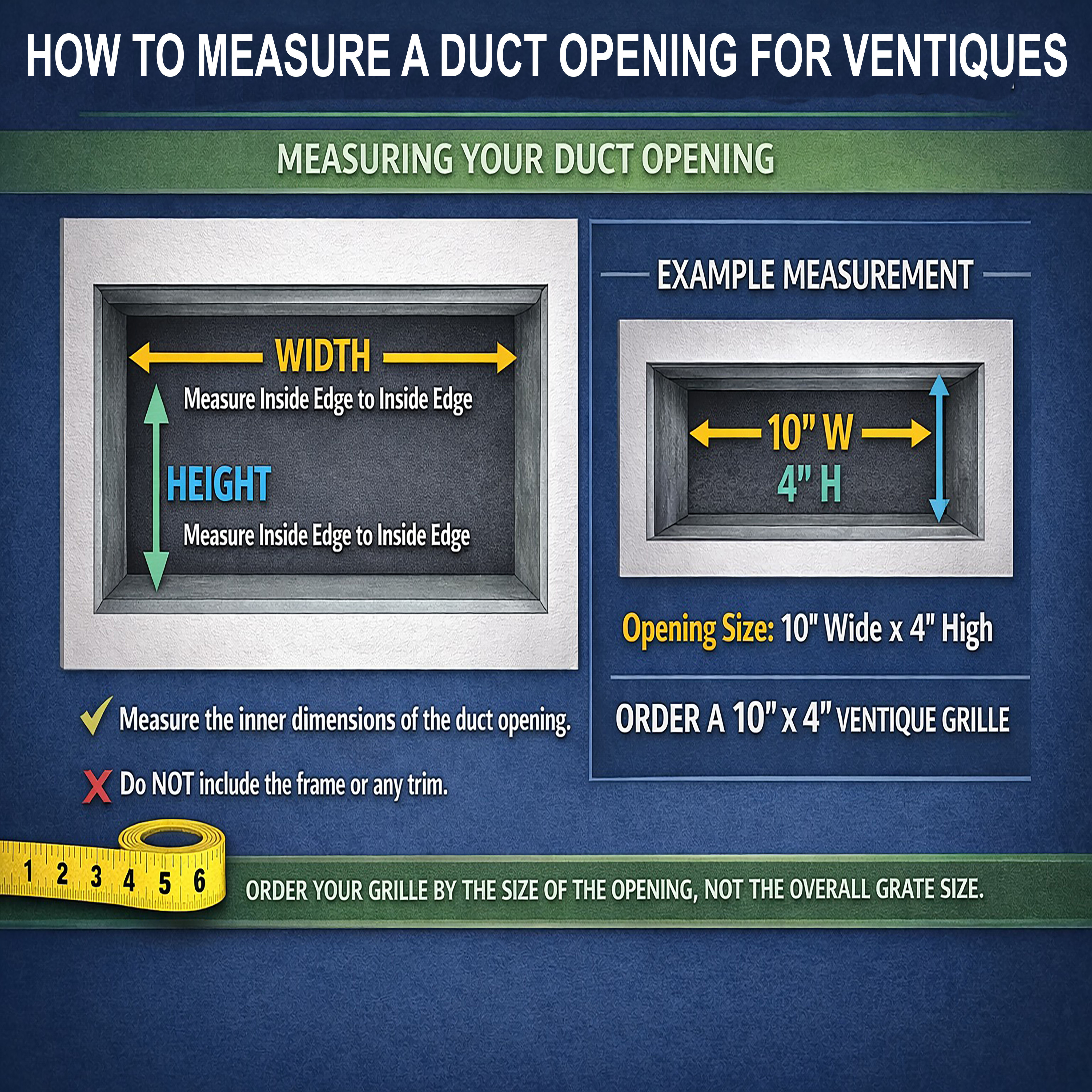
If someone wants a vent that actually fits, that person has to ignore the old vent cover sitting on the floor. This is where most homeowners go wrong. When they look at a vent size online—like a 4×10 or a 2×12—those numbers are referring to the internal duct opening, not the metal plate they step on.
The decorative plate (the faceplate) is always larger than the hole so it can overlap the flooring and stay in place. If someone measure that outer plate and purchase a vent based on those dimensions, the “insert” part will be way too big to drop into the hole. To get it right, peoples have to measure the hole in the floor itself.
Vent Measurement: Accuracy, Airflow Mechanics, and Structural Integration
1. The Golden Rule of Vent Sizing
Before picking up a tape measure, peoples have to understand the industry standard for labeling. Almost every “return” or “exchange” at a hardware store happens because of a single mistake: measuring the old cover instead of the hole.
The Hole is the Size If see a vent labeled as 4″ x 10″, that number represents the duct opening, not the metal plate which step on. The decorative faceplate will always be larger—usually about 1 to 2 inches wider and longer—to ensure it overlaps the flooring and stays in place. If measure the outside of old vent, it will end up buying a replacement that is far too big to fit into the floor.
2. Pre-Measurement Checklist
Remove the old hardware: Use a screwdriver to remove any mounting screws. If the vent is stuck due to old paint, grease or floor finish, one can use a utility knife around the edge to break the seal.
• Clear the lip: Use a vacuum to remove dust, construction debris, or carpet fibers from the edge of the duct. Even a small buildup of grit can throw off the measurement by 1/8th of an inch.
• Check the “Boot”: Look inside. The metal box connecting the duct to floor is called the “boot.” Ensure it isn’t bent or crushed. If the metal is warped, straighten it with pliers before measuring.
3. The Step-by-Step Measurement Process
Step A: Measure the Width correctly
Place the end of the tape measure against the inside wall of the duct opening. Pull it across to the opposite inside wall. Note the exact measurement wisely. Common widths for residential ducts are 2.25 inches, 4 inches, and 6 inches.
Step B: Measure the length
Measure the long side of the rectangle from the inside edge to the inside edge. Standard lengths usually fall at 10, 12, or 14 inches.
Step C: Verify the Shape
Ducts are rarely perfect rectangles, especially in older homes. Measure the width at both ends of the hole. If one side is 4 inches and the other is 4.25 inches, the duct is “out of square.” In this case, it should stick to the smaller dimension (4 inches) to ensure the vent insert actually drops into the hole.
4. Why Precision Impacts HVAC Performance
If choose a vent that is too small for the opening, it might think “I’ll just screw it into the subfloor and it might work well.” This gives birth to significant mechanical issues:
1. Static Pressure Buildup: HVAC blowers are calibrated to push air against a specific amount of resistance. Restricting that air at the floor vent creates “backpressure.” This forces the motor to run hotter and die younger.
2. Air Leakage: When a vent doesn’t seal against the duct boot, conditioned air escapes into the space between floor and the ceiling below (or into the crawlspace). This will end up paying to heat the “inside” of the floors rather than living room.
3. Noise Issues: High-velocity air forced through a small or poorly fitted gap creates a whistling or rushing sound. Correct sizing keeps the air quiet.
A. The Fundamental Distinction in Sizing Standards
In the ventilation industry, there is a standardized protocol for labeling and sizing. The most frequent error made during the replacement process is a misunderstanding of what a “size” actually represents.
The “Opening vs. Cover” Principle
A vent size (e.g., 4 x 10 inches) always refers to the internal dimensions of the duct opening. It does not refer to the external dimensions of the decorative grille. The grille, or faceplate, is intentionally designed with an “overage” or flange. This flange allows the vent to sit securely on the floor surface or within a frame.
For example, a standard 4″ x 10″ vent might have an actual external footprint of 5.5″ x 11.5″. If a technician or homeowner measures the external plate of an old vent and purchases a new one based on those numbers, the new unit’s “insert” (the part that drops into the floor) will be far too large for the existing ductwork.
Terminology of Components
• Duct Boot: The metal transition piece which connects the circular or rectangular ducting to the floor opening.
• Register: A vent cover that includes a built-in damper (a mechanism to open/close airflow).
• Grille: A vent cover that allows air to flow freely without a closing mechanism.
• Aperture: The physical hole in the floor through which air passes.
B. Tools and Preparation for High-Precision Measurement
To achieve a fit that maintains the seal of the HVAC system, measurements must be precise to within 1/8th of an inch. Using improper tools can lead to “slop” in the fit, which causes air leakage and whistling noises.
Required Equipment
1. Steel Measuring Tape: A steel tape is more rigid & accurate than fabric or plastic tapes.
2. Calipers (Optional for Flush Mounts): In high-end installations where the vent must be flush with the floor, calipers help determine the accurate thickness level of the flooring material.
3. Flashlight: Essential for inspecting the duct boot for obstructions or structural damage that might impede the vent’s damper.
4. Straight Edge: To check if the subfloor is level around the aperture.
Pre-Measurement Protocol
Before measuring the vent, clean the surface & surrounding wall. Old registers often accumulate debris or may be stuck to the floor with dried finish or paint. Use a flat-head screwdriver or a putty knife to carefully break the seal of the old vent. Please don’t damage the floor. Once removed, vacuum the interior lip of the duct boot. Dust and grit can add a slight thickness to the opening, leading to a “tight” measurement that doesn’t reflect the actual metal-to-metal dimensions.
C: Measurement Guide
Step 1: Identify the Interior Edges
Place the measuring tape against the inside wall of the duct. Now, look for the distance from the metal wall on one side to the metal wall on the parallel side.
Step 2: Record Width and Length of Duct Opening
• Width: The width of the duct opening can be 2.25, 4, or 6 inch.
• Length: 10, 12, or 14 inches. Record these numbers exactly as they appear on the tape. If the duct is slightly compressed or bent, measure in the center of the opening rather than the corners.
Step 3: Checking for “Square”
A duct opening that is not perfectly rectangular is known as being “out of square.” To check for this, measure the diagonals. Measure from the top-left corner to the bottom-right corner, then from the top-right to the bottom-left. If the two diagonal numbers are the same, the opening is square.
D: Standard Sizing V/S Modern Variations
Standard Residential Dimensions (Inches)
• 2.25 x 10 & 2.25 x 12: Typically, right for bathrooms, small hallways
• 4 x 10: The most common residential floor size for standard bedrooms and living areas.
• 4 x 12: Used in larger rooms or in areas where higher air volume is a need.
• 6 x 10 / 6 x 12: Common in older homes and commercial-to-residential conversions.
Non-Standard and Historic Sizes
Homes, which were built before 1950, ductwork was often hand-formed. It may find openings like 5″ x 11″ or 3″ x 10″.
1. Custom Grilles: Many manufacturers now offer custom-sized wood vents.
2. Aperture Modification: A flooring professional can sometimes trim the subfloor or use a transition frame to allow a modern 4×10 or 4×12 vent to fit.
E: Installation Mechanics – Drop-In vs. Flush-Mount
The measurement strategy shifts depending on how the vent is intended to sit relative to the floor.
The Drop-In (Top-Mount) Process
Drop-in vents are the industry standard for existing floors. The vent has a “lip” that hangs over the edge of the flooring.
• Measurement Tolerance: High. Because the lip covers the edge of the floor, the hole in the floor can be slightly larger (up to 3/4 inch) than the vent’s insert.
• Consideration: Ensure the faceplate is not so large that it hits a nearby baseboard or transitions into another room’s flooring.
The Flush-Mount Process
Flush-mount vents sought after for their seamless appearance with hardwood floors and Ceramic Tile, LVT, LVP, Porcelain Tile. These are installed during the flooring installation.
• Measurement Tolerance: up to ½”. The vent frame will sit on top of the subfloor.
• Critical Data Point: It must know the thickness about the flooring (e.g., 3/4″ solid oak vs. 1/2″ engineered wood). The vent frame must match this thickness exactly, or the vent will create a tripping hazard. Also, it must be decided whether will use metal or a wood vent.
F: Airflow Dynamics and Static Pressure
Why does a 1/2-inch difference in vent size matter? To understand this, must look at the physics of airflow within a closed system.
The Concept of “Free Area”
The “free area” of a vent is the total square footage of the gaps through which air can actually pass. A 4×10 vent has a total area of 40 square inches. If installing a vent that is too small for the duct: (Please remember This is all determined by the HVAC contractor.)
1. Increased Air Velocity: The same amount of air is forced through a smaller hole. This increases the speed of the air, often creating a “whistling” sound.
2. Blower Motor Strain: The HVAC unit’s blower motor is designed to push air against a specific amount of resistance. If the vents are too small, the resistance increases. Over time, this leads to premature motor failure and higher electricity bills.
3. Short Cycling: The system may struggle to reach the target temperature because the air is being “choked” at the exit point, causing the furnace or AC to turn on and off more frequently.
G: Material Science in Vent Design
The material of the vent cover affects both the measurement longevity and the system’s performance.
Metal (Steel and Aluminum)
• Pros: Extremely thin profiles allow for maximum airflow. Very durable in high-traffic areas.
• Measurement Tip: Metal does not expand. If the duct opening is 4 inches wide, a metal vent with a 4-inch insert will fit perfectly.
Wood
• Pros: Matches flooring perfectly.
• Measurement Tip: Wood is thicker than metal. A wooden vent might have thicker slats, which reduces the “free area.” When measuring for wood vents, it is often recommended to use a slightly larger duct opening if the system is being newly designed to compensate for the thicker material.
Plastic/Polymer
• Pros: These vents are rust-proof, but not durable
• Measurement Tip: Plastic vents often have thicker frames. Ensure the “drop-in” portion does not have reinforcing ribs that make it wider than the duct opening.
H: Measuring for Wall and Ceiling Vents
• Gravity: Ceiling vents require secure screw holes. When measuring for these, ensure the “flange” of the vent has enough solid material (drywall or wood) around the duct to take a screw.
• Directional Airflow: Wall vents often require “multi-way” throw patterns. Measurement must go for which way the air needs to be directed.
I: The Role of Dampers and Airflow Control
A vent is not just a hole; it is a valve. The damper is the mechanism that allows the user to shut off air to a specific room.
Measuring for Damper Clearance
When the damper is “open,” the blades extend downward into the duct. If ductwork has an immediate 90-degree turn (common in shallow floor joints), a standard vent damper may hit the bottom of the duct and stay partially open. In these cases, it is must to measure the vertical depth of the duct. If it has less than 2 inches of depth, it may need a “low-profile” or “shallow” register.
J: Professional Tips for a Seamless Fit
1. The Paper Template: If it is having an irregular opening, place a piece of paper over the hole and rub a pencil over the edges to create a “map” of the opening. Take this template to the supplier.
2. Check for Obstructions: Before finalizing a size, check for carpet tack strips, floor nails, or stray pieces of subfloor that might be protruding into the duct space.
3. Standardize The Home: If home has a mix of 4×10 and 4×12 vents, consider if the ductwork allows to standardize them to a common size during a remodel to simplify future maintenance.
Measuring a vent correctly is not about tools. It requires understanding what actually the size is. The visible cover is not the reference point—actually the duct opening is the correct size. When measurements are taken from the wrong surface, everything that follows becomes misaligned, from fit to airflow. A vent is designed to work with the dimensions of the opening it serves, not the frame that sits above it.
Remember to measure the inner edge to inner edge, length followed by width –all with an eagle eye and consistency. Repeating the measurement twice is not redundancy; it is verification.
Conclusion
Finding the right vent size is basically where carpentry meets mechanical engineering. If it is about to stick to the industry standard—measuring the actual duct opening—and account for specific floor style, it is doing more than just buying hardware. It is going to protect the lifespan of the entire HVAC system.
Nick
Ventiques
+1 (320)292-7582
nick@ventiques.com
Visit us on social media:
LinkedIn
Instagram
Facebook
YouTube
Innovation Meets Style. Check out the all-new adjustable height flush mount floor vent by Ventiques
Legal Disclaimer:
EIN Presswire provides this news content “as is” without warranty of any kind. We do not accept any responsibility or liability
for the accuracy, content, images, videos, licenses, completeness, legality, or reliability of the information contained in this
article. If you have any complaints or copyright issues related to this article, kindly contact the author above.

Media gallery