
The Business Research Company’s Cost of Capital Outlook 2027: Why the Age of Cheap Money Is Over and What It Means for Business Investment
LONDON, GREATER LONDON, UNITED KINGDOM, November 26, 2026 /EINPresswire.com/ — Key takeaways
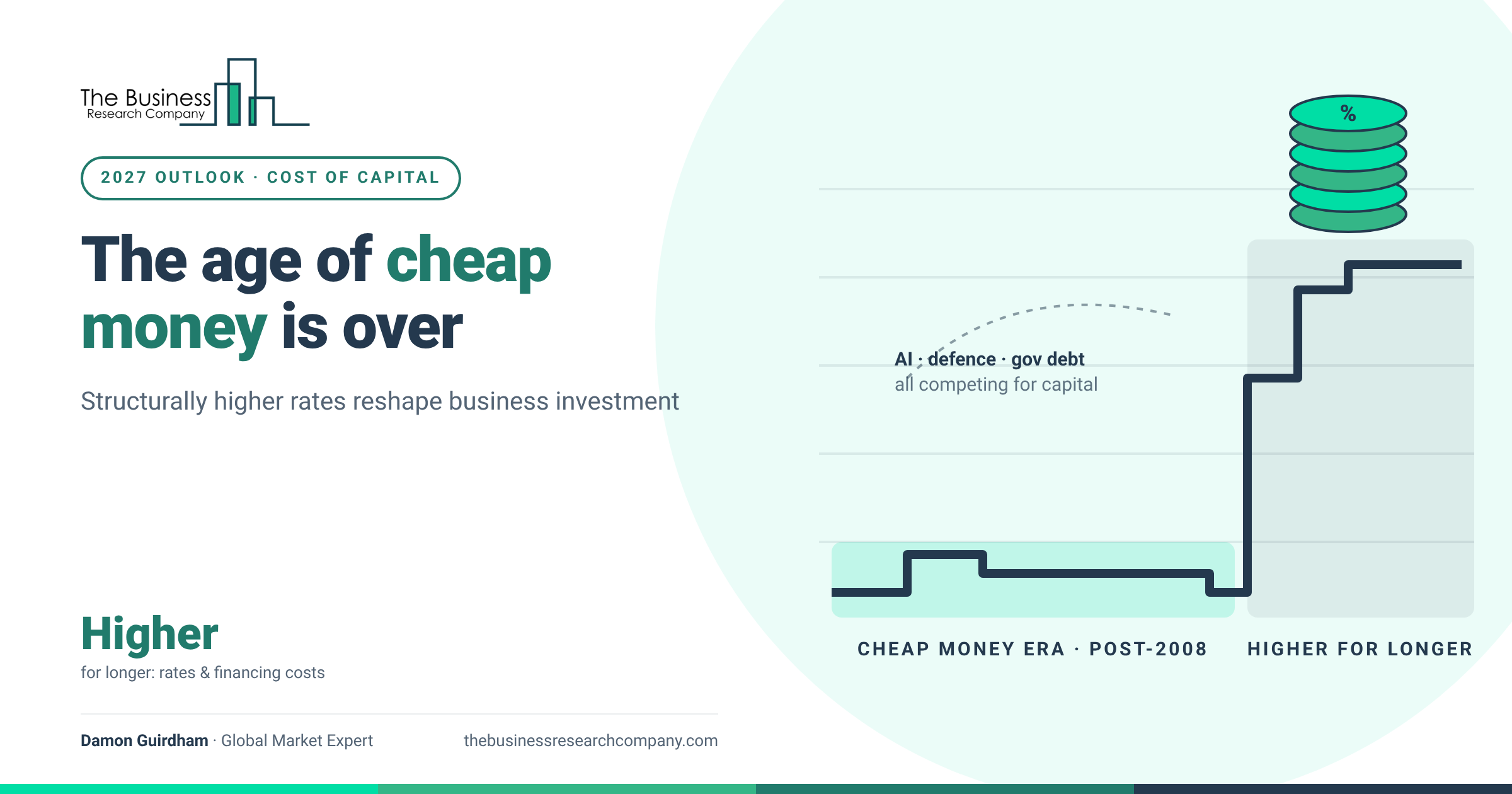
• Interest rates and financing costs will stay structurally higher than businesses grew used to after 2008.
• AI infrastructure, defence spending and persistent government borrowing are all competing for capital at once.
• Businesses that cannot offer exceptional returns, often through automation, will struggle to attract investment.
For more than a decade after the 2008 financial crisis, money was cheap. Central banks held interest rates near zero and bought vast quantities of bonds through quantitative easing. A generation of business leaders and investors came to treat low-cost capital as normal.
During our roundtable on the 2027 outlook, I argued that this isn’t coming back. Capital is in high demand, and as a consequence will be expensive compared with what people have become used to.
Put plainly, interest rates and financing costs will stay structurally higher than businesses grew used to after 2008, and that will restrain growth in the traditional economy.
Testing your investment plans against a higher cost of capital? Let us get to know each other.
Why Demand for Capital Is Rising: AI, Defence and Government Borrowing
Three big claims on capital are landing at once. The first is the AI build-out. Data centres, chips, power and grid infrastructure require enormous sums, and the companies building them are borrowing and raising equity at unprecedented scale.
The second is defence. European governments are increasing defence spending substantially, and defence technology companies are raising capital to grow. The third is government borrowing. Many governments carry high debt and persistent deficits, and they must keep borrowing to fund them.
Each of these would put upward pressure on the cost of capital on its own. Together, they make a return to the post-crisis era of cheap money very unlikely.
The pressure isn’t limited to Europe. In the US, AI capex is absorbing capital on a scale rarely seen outside wartime, and across Asia-Pacific a strong dollar and rising US bond yields have pulled foreign investment out of local markets. Capital is scarce almost everywhere at once.
• AI infrastructure: data centres, chips, power and grids
• Defence: rising budgets and a wave of defence technology investment
• Government deficits and high debt-to-GDP ratios
• Climate adaptation and infrastructure renewal
Our analysts can size the cost of capital opportunity for your region. Start a conversation with us.
How Higher Interest Rates Will Restrain Growth in the Traditional Economy
When capital is expensive, investors become more selective. Projects that made sense at near-zero rates no longer clear the bar. That hits sectors with modest returns hardest: traditional manufacturing, real estate, retail and parts of the service economy.
Businesses that can’t offer exceptional returns, often through automation and productivity gains, will struggle to attract investment. Those that can, such as companies capturing AI-driven efficiency, will continue to find capital, albeit at a higher price.
Want to understand how financing conditions affect your sector? Get in touch with our team.
What the End of Cheap Money Means for Private Equity and Dealmaking
Private equity built much of its model on low-cost debt. As my colleague Eugene Outler noted at the roundtable, private equity has been driving a lot of mid-market activity, including acquisitions of former competitors. Higher financing costs make leverage more expensive and raise the bar for returns, which will shape which deals get done and how they’re structured.
At the same time, firms are under pressure to deploy capital already committed to them. That will keep activity going in sectors with strong growth, such as defence and AI infrastructure, even as deals in lower-growth sectors become harder to finance.
We track the cost of capital market across more than 60 countries. Let us get to know each other.
How Businesses Should Plan for a Higher Cost of Capital in 2027
1. Revisit hurdle rates and investment cases built on post-2008 assumptions
2. Prioritise projects with clear, near-term returns
3. Use automation and productivity gains to strengthen the investment case
4. Secure financing early where possible, and plan for refinancing at higher rates
Investment won’t stop. It means it becomes more selective, and that the gap widens between businesses that can show strong returns and those that can’t.
If you’re refining your 2027 investment strategy, book a call with our research team.
Our research team works with strategy, investment and market intelligence teams every week. If that sounds useful, let us get to know each other.
Frequently asked questions
Will interest rates return to post-2008 lows?
We don’t expect so. Capital is in high demand from AI, defence and government borrowing, which will keep financing costs structurally higher.
What is driving demand for capital?
The AI infrastructure build-out, rising defence spending and persistent government deficits, all at once.
Which businesses will struggle to raise capital?
Those that can’t offer exceptional returns, particularly in lower-growth traditional sectors.
Speak With Our Expert:
Saumya Sahay
Americas +1 310-496-7795
Asia +44 7882 955267 & +91 8897263534
Europe +44 7882 955267
Email: marketing@tbrc.info
The Business Research Company – www.thebusinessresearchcompany.com
Follow Us On:
• LinkedIn: https://in.linkedin.com/company/the-business-research-company
About The Business Research Company
The Business Research Company is a market intelligence firm with more than 350 researchers and offices in the UK, the US and India. Its Global Market Model covers 27 industries and more than 60 geographies, providing market sizes, forecasts and analysis for businesses, investors and governments worldwide.
Oliver Guirdham
The Business Research Company
+44 7882 955267
info@tbrc.info
Visit us on social media:
LinkedIn
Legal Disclaimer:
EIN Presswire provides this news content “as is” without warranty of any kind. We do not accept any responsibility or liability
for the accuracy, content, images, videos, licenses, completeness, legality, or reliability of the information contained in this
article. If you have any complaints or copyright issues related to this article, kindly contact the author above.

Media gallery