LA JOLLA, CA, UNITED STATES, June 22, 2026 /EINPresswire.com/ — Many ocean ecosystems have a “hidden green zone” below the surface where chlorophyll—an indicator of photosynthesis—reaches a local peak. Scientists call this band the subsurface chlorophyll maximum layer or SCML. It is dimmer than surface waters and is often shaped by nutrient gradients, making it an important, yet comparatively understudied, part of the ocean’s biological engine.
In a new study, published in the journal Nature Communications, researchers show that Pelagomonas calceolata, one of the most abundant single‑celled algae in the ocean, is exceptionally well adapted to the SCML’s defining challenge: low light combined with low iron. The work was led by Andrew Allen, Ph.D., a professor at the J. Craig Venter Institute (JCVI) and Scripps Institution of Oceanography at UC San Diego.
While iron is only needed in tiny amounts, it is both limited in availability and essential for photosynthesis and for enzymes that help cells build biomass. In the SCML, less light can push cells to invest in more photosynthetic machinery—many components of which require iron—making survival at depth especially challenging.
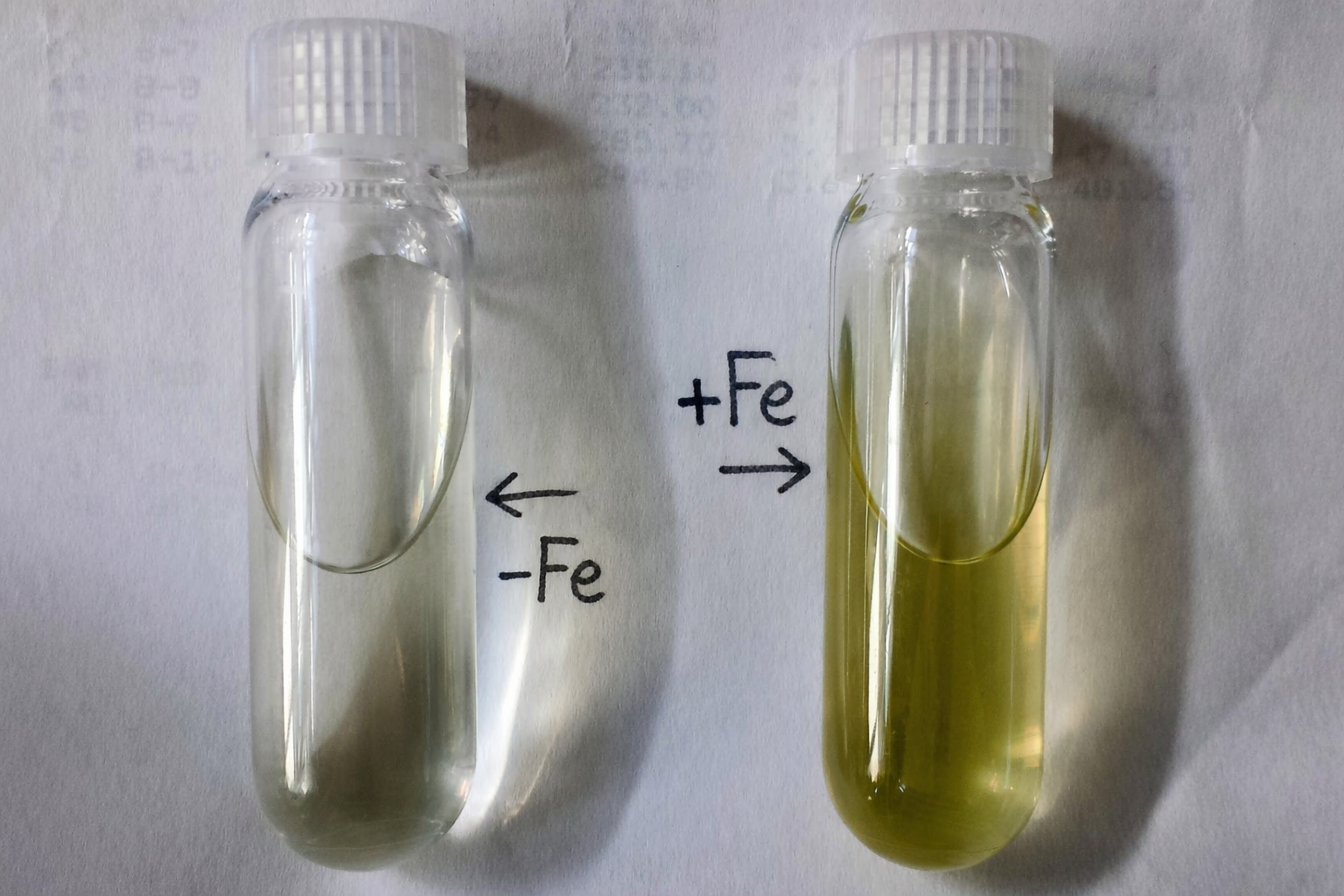
To uncover how P. calceolata navigates this dual challenge, the team followed the organism under tightly controlled conditions across day–night cycles. They grew cultures under four core conditions—high vs. low light crossed with iron‑rich vs. iron‑limited media—and tracked responses to controlled “events,” including adding iron back (iron resupply) and adding a strong iron‑binding compound called DFOB that reduces free iron.
Tyler Coale, Ph.D., first author while a doctoral student splitting his time between JCVI and Scripps Oceanography, said iron limitation experiments are hard to run because it is easy to accidentally introduce iron from lab materials. “Iron is abundant on land but scarce in many marine environments. To replicate those low levels, we used clean rooms and acid-cleaned bottles to prevent contamination, allowing precise control of iron and measurement of physiological, gene expression, and proteomic changes. These experiments show that P. calceolata incurs major costs under iron starvation, rebounds quickly when iron returns, and relies on strategies that support survival in low-iron oceans.”
Across both light levels, low iron reduced photosynthetic performance and cellular carbon, and the combined low‑light/low‑iron condition produced the smallest biomass. The team also found that P. calceolata conserves iron by switching on iron‑saving pathways (including flavodoxin) and can still access iron when it is locked up in strong organic complexes—important because much ocean iron is found in these bound forms. Iron scarcity also shifted nitrogen use, consistent with reduced reliance on nitrate processing and greater emphasis on alternative strategies.
Allen said the work helps illuminate a key but less visible part of ocean productivity. “The subsurface chlorophyll maximum is a vast, dim habitat that helps regulate how carbon and nutrients move through the ocean,” he said. “Yet we still don’t have the same level of mechanistic understanding there as we do at the surface. What this study shows is that P. calceolata has a highly tuned strategy for living where both light and iron are scarce—and because it’s so abundant, those strategies have a tremendous impact on the ocean’s biological engine.”
This study builds on a broader body of JCVI and Scripps Oceanography‑featured work led by Allen and collaborators that uses genomic and multi‑omics tools to understand how marine microbes influence ecosystem function and contribute to the carbon cycle.
This work was supported by National Science Foundation grants OCE-1756884, OCE-2326965, and California Current Ecosystem Long-Term Ecological Research grants OCE 163762 and OCE-2224726; the Simons Collaboration on Principles of Microbial Ecosystems (PriME) grant 970820; the Simons Foundation Grant 504183; and NSERC Discovery Grant RGPIN-2015-05009.
The complete study, “Molecular and physiological acclimation to low light and iron scarcity in a globally abundant oceanic pelagophyte,” may be found in the journal Nature Communications. Collaborators included Dalhousie University (Canada) and the University of South Bohemia (Czech Republic).
About J. Craig Venter Institute
The J. Craig Venter Institute (JCVI) is a not-for-profit research institute in Rockville, Maryland and La Jolla, California dedicated to the advancement of the science of genomics; the understanding of its implications for society; and communication of those results to the scientific community, the public, and policymakers. Founded by J. Craig Venter, Ph.D., JCVI is home to approximately 120 scientists and staff with expertise in synthetic biology, human and evolutionary biology, genetics, bioinformatics/informatics, information technology, high-throughput DNA sequencing, genomic and environmental policy research, and public education in science and science policy. JCVI is a 501(c)(3) organization. For additional information, please visit www.jcvi.org.
Matthew LaPointe
J. Craig Venter Institute
+1 301-795-7918
email us here
Visit us on social media:
LinkedIn
Bluesky
Instagram
Facebook
YouTube
Other
Legal Disclaimer:
EIN Presswire provides this news content “as is” without warranty of any kind. We do not accept any responsibility or liability
for the accuracy, content, images, videos, licenses, completeness, legality, or reliability of the information contained in this
article. If you have any complaints or copyright issues related to this article, kindly contact the author above.

Media gallery