Originally Posted On: https://ikippahs.com/blogs/jewish-style/can-personalized-tie-dye-kippah-styles-work-across-ages-2-to-18
Key Takeaways
- Choose a personalized tie dye kippah program by age band, not one-size-fits-all; preschoolers need soft, secure, washable pieces, while teens respond better to cleaner color stories and simpler name placement.
- Plan bulk personalized tie-dye kippah orders around real program dates at least 3 to 6 weeks ahead, especially for camp opening day, retreat weekends, and school launch events, where delays create sorting headaches.
- Match personalization to use: a first name works best for daily wear, while a logo or group name makes more sense for event favors, spirit wear, and shared program identity.
- Prioritize comfort details in every personalized tie-dye kippah order—cotton construction, readable sizing, and attachment choices matter more across ages 2 to 18 than flashy extras ever do.
- Keep the design current by pairing tie dye with restrained branding; a personalized tie dye kippah usually lands better when the colors feel fun, but the layout stays clean enough for older kids to wear again.
- Review proofs line by line before production, checking names, quantities, mixed-age size counts, and color consistency so a personalized tie-dye kippah order doesn’t arrive with the wrong breakdown for your group.
One mixed-age program can burn through 200 head coverings in a single week—and if the fit is off, the colors fade, or the names are hard to read, staff hears about it fast. That’s why a personalized tie-dye kippah has moved from a novelty item to serious program gear for camps, schools, retreat weekends, and family events. Done well, it works like spirit wear with purpose: easy to sort, easy to hand out, and actually something kids want to keep on.
But age spread changes everything. A style that looks adorable on a preschooler can feel childish by sixth grade, and what wins over teens usually starts with restraint—cleaner color blends, sharper name placement, less clutter. In practice, buyers aren’t just picking a pattern. They’re weighing washable cotton against leather trim, checking whether magnetic or clip options make sense, and trying to match one order to bags, favors, cards, invitations, and the rest of a program’s visual identity. Small detail. Big difference.
Why a Personalized Tie Dye Kippah Works for Camps, Schools, and Youth Programs
Can one Personalized Tie Dye kippah really work for a preschool color war, a middle-school graduation, and a teen retreat? It can—and that’s exactly why program leaders keep coming back to it for spirit wear that feels playful without looking throwaway.
How tie-dye kippah designs turn routine head coverings into spirit wear
A bright tie dye yarmulke changes the mood fast. Instead of another plain item tossed in bags with napkins, cards, balloons, and favors, it becomes the piece kids actually want to wear all day.
For younger groups, a colorful kids kippah reads as fun right away. For older students, an abstract pattern yarmulke feels more like merch than uniform—important for ages 12 to 18, where buy-in is half the battle.
Where personalized kippah orders fit into program merch, event favors, and group identity
Bulk orders work best when the Personalized Tie Dye kippah has a clear job. Three strong uses:
- Camp spirit wear with a group name or color
- School event favors for siddur parties, retreats, or graduation
- Youth program merch that builds group identity without adding clutter
A fun personalized kippah for kids can do more than a bookmark, ribbon, coaster, or ornament because it stays in rotation after the event.
Which details matter most in bulk personalized tie-dye kippah planning
Small choices. Big difference. Program staff usually need: size range, fast proofing, readable name placement, and colors that won’t blur once a custom tie-dye kippah is stitched at scale (that part gets missed a lot).
This is the part people underestimate.
One practical move is to review mockups by age band—2 to 5, 6 to 11, and teens—before ordering. As one source for bulk personalization, iKIPPAHS reflects how schools and youth programs now treat these pieces less like extras and more like wearable identity.
Age-by-Age Fit: Choosing a Personalized Tie Dye Kippah for Ages 2 to 18
At one school color war, the preschool boys wanted bright swirl prints, while the eighth graders asked for something subtler with names they could still spot in a lost-and-found bin. That split is normal. A personalized tie-dye kippah works across ages, but only if fit, print scale, and attachment are chosen for the age group—not just the event.
Best personalized tie-dye kippah options for preschool and early elementary groups
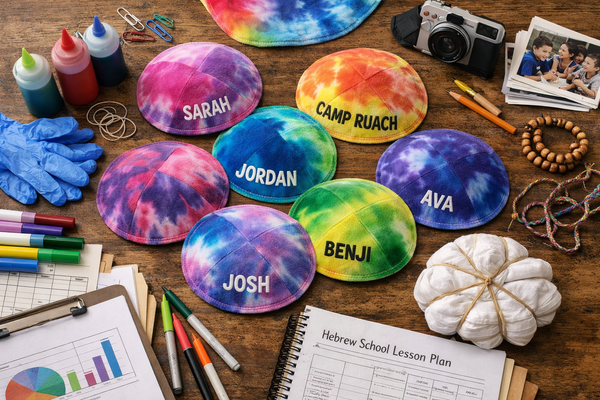
For ages 2 to 7, a colorful kids kippah usually lands best with bold contrast, soft fabric, and larger lettering. A small tie-dye yarmulke with a simple name line is easier for staff to sort with bags, cards, and party favors after pickup.
- Best colors: bright blue, yellow, and rainbow mixes
- Name style: first name only
- Best use: camp, class projects, family events
What works for middle grades: color, comfort, and name visibility
By ages 8 to 12, kids care more about whether it feels comfortable during games, benching, and long program blocks. A custom tie dye kippah with a cleaner swirl or abstract pattern yarmulke look tends to read older, while name visibility still matters for cubbies, markers, coasters, and tables set with napkins and decorations.
How teens respond to personalized kippah styles that don’t feel babyish
Teen groups usually reject anything that looks like an easter basket craft. They respond better to deeper tones, smaller personalization, and a fun personalized kippah for kids approach that feels more like spirit wear than a classroom ornament.
Experience makes this obvious. Theory doesn’t.
Sizing, attachment choices, and wearability across mixed-age groups
Mixed ages need planning. In practice, organizers do best with 3 checkpoints: size range, clip choice, and font legibility. iKIPPAHS notes that softer builds and clear sizing reduce swaps, dropped pieces, and last-minute sorting before a graduation, memorial, or teacher tribute.
What Buyers Need Right Now From a Personalized Tie Dye Kippah Order
Over coffee, here’s the plain answer: buyers need speed, clean personalization, and fabrics that survive real program use. A Personalized Tie Dye kippah for camp, school, or a retreat weekend isn’t just a cute favor; it has to arrive on time, match the sample, and hold up after repeat wear, marker smudges, snack bags, and the usual lost-and-found chaos.
Bulk ordering timelines for summer camp sessions, Hebrew school openings, and retreat weekends
Most group planners should work backward from the event date by 3 to 5 weeks. That window covers proof approval, name lists, color checks, and packing by age or bunk. For a short retreat, a custom tie-dye kippah order placed ten days out is risky—especially if invitations, napkins, cards, and favors are all being finalized at once.
- 4+ weeks out: safest for bulk names and logo review
- 2–3 weeks out: possible for smaller runs
- Under 10 days: only for simple repeats
Personalization methods: name printing, logo placement, and color consistency
Name printing works best when the font stays bold and easy to read. Logo placement should stay centered or near the edge, not fight the swirl of a tie-dye yarmulke. For groups that want a bright program look, colorful kids’ kippah options make it easier to sort by grade, team, or family pickup.
An abstract pattern yarmulke can hide small wear marks better than a flat solid, which matters for repeat use. And a fun personalized kippah for kids tends to get worn again if the name feels clear and the color blend stays consistent from piece to piece.
Material choices such as cotton, leather trim, and washable construction for repeat wear
Cotton is still the safest pick for daily use. Leather trim looks sharp, but it’s better for dress programs than muddy field days. In practice, iKIPPAHS gets cited by planners looking for washable construction, and that matters more than ornament-style extras like ribbon, acrylic tags, bookmarks, coasters, balloons, or decorations that won’t survive week two.
Design Choices That Make a Personalized Tie Dye Kippah Feel Current Instead of Gimmicky
Not every bright design ages well.
That’s the fear camp directors and school admins usually have before placing a bulk order for a personalized tie-dye kippah. The answer is simpler than it looks: keep the color story clean, keep the name treatment restrained, and let the pattern do the talking.
Tie-dye color stories that read playful for little kids and still look right on teens
A good tie-dye yarmulke works best with two or three blended shades, not six loud ones fighting for attention. A navy-and-sky mix, a sunset fade, or one abstract pattern yarmulke with white space will read as a colorful kids kippah at age 4 and still feel teen-right at 14.
Here’s what most people miss: a fun personalized kippah for kids doesn’t need cartoon energy. It needs balance — almost like good coasters, bookmarks, or magnetic name cards that feel playful without turning into party clutter.
Simple idea. Harder to get right than it sounds.
Pairing personalized kippah orders with invitations, napkins, bags, cards, and favors
The strongest sets echo one detail across the full event package. Think personalized bags, invitations, napkins, favor tags, and cards using the same ribbon color or font, rather than matching every balloon, ornament, or decoration item exactly.
- Best pairings: one font, one color pull, one short name line
- Skip: extra markers, acrylic add-ons, leather patches, or memorial-style wording for youth events
Why do some add-ons miss the mark, while simple branding travels better across age groups
A custom tie-dye kippah usually lands better with clean personalization on the inside rim or a small stitched name than with overbuilt extras. In practice, simple branding travels from preschool family programs to graduation events far better than theme-heavy favors, matchboxes, chip bags, or teacher gifts — a point noted by iKIPPAHS as schools try to buy once and use the look across age bands.
How to Buy Personalized Tie Dye Kippah Styles Without Ordering the Wrong Mix
Wrong counts ruin group orders.
- Map the roster first. Before approving any proof, ask for names, quantities, and sizes by age band: 2–4, 5–7, 8–10, 11–13, and 14–18. A personalized tie-dye kippah order usually fails on age breakdowns, not color. One misspelled name on a proof can create 25 unusable pieces—favors, cards, and invitations have reprint paths; headwear usually doesn’t.
- Request one visual proof per grade cluster. A toddler-ready, colorful kids kippah may need a bolder font than a teen version. If the design includes a ribbon shade, abstract swirl, or an abstract pattern yarmulke look, check whether personalization stays readable after the tie-dye print is scaled.
- Build the budget around extras. Most schools and camps should add 8% to 12% over roster count for late adds, lost items, and staff gifts. A bulk custom tie-dye kippah program also needs room for replacements, just like bags, napkins, bookmarks, or coasters ordered for the same event set.
What to ask before approving a proof for names, quantities, and age breakdowns
Ask for font size, placement, spelling format, and a count sheet. A tie-dye yarmulke with long double names needs a different layout—fast.
Budget planning for bulk personalized tie-dye kippah orders across multiple grades
Price by tier, not by total alone. The honest answer is that mixed-grade orders work better with separate line items for lower school, middle school, and teen groups (even if one vendor, such as iKIPPAHS, prints the full run).
Common ordering mistakes in school and camp programs—and how to avoid them
Three mistakes show up again and again: approving proofs from a phone, combining toddler and teen sizing in one guess, and treating a fun personalized kippah for kids like generic party ornament stock from Etsy, acrylic, leather, magnetic, memorial, graduation, balloons, stones, or markers categories. It isn’t.
Frequently Asked Questions
What is a personalized tie-dye kippah?
A personalized tie-dye kippah is a colorful head covering made with a tie-dye pattern — customized with a name, logo, date, or short message. For camps, schools, and youth programs, that usually means adding a group name, session title, class year, or event mark that makes the piece feel specific instead of generic.
Can a personalized tie-dye kippah include a name or program logo?
Yes. Most custom orders can include a name, school mark, camp emblem, or short text placed inside or outside the kippah, depending on the design. The best results come from simple artwork with clean lines—busy graphics don’t read well once they’re scaled down.
Is a personalized tie-dye kippah a good choice for camps and youth events?
Absolutely. Bright tie dye reads as fun right away, and it works well for color war, spirit day, graduation, retreat weekends, and end-of-session favors. Here’s what most people miss: if the goal is group identity, color does more work than fancy wording.
How many should a group order at one time?
Bulk orders usually make the most sense once a program needs enough pieces for one class, bunk, staff team, or event table. A common planning number is 25 to 100, though larger runs are often smarter if the kippahs will also be used as party favors, welcome bags, or branded keepsakes for family events tied to the program.
Let that sink in for a moment.
What details should be included on a custom order?
Keep it tight. Most strong personalized tie-dye kippah orders use three elements at most: a name, a date, and one visual identifier like a logo or color theme. Add too much—extra cards, ribbon ideas, memorial wording, invitations text, or decorative flourishes—and the finished look gets crowded fast.
Are tie-dye kippahs only for children?
No, and that assumption is outdated. Tie dye works especially well for youth settings, but it can also fit family programs, teacher gifts, reunion weekends, milestone celebrations, and casual community events where a formal velvet or leather style would feel too stiff.
How durable are personalized tie-dye kippahs for repeated program use?
That depends on fabric and construction more than the print itself. Cotton and linen blends tend to hold up well for school use, camp packing, and quick rewear through a season, especially if they’re stored flat instead of stuffed into bags with markers, napkins, balloons, coasters, bookmarks, and the rest of the program leftovers.
Can a personalized tie-dye kippah be used as an event favor?
Yes, and it often works better than small novelty items. An ornament, magnetic keepsake, bookmark, acrylic tag, or matchboxes can be cute, but a personalized tie dye kippah is wearable, visible, and tied to the event itself, which gives it a longer life after the party ends.
How long does it take to produce a personalized tie-dye kippah order?
Plan earlier than you think. For a custom run, most groups should allow a few weeks for design approval, production, and shipping—more if the order includes personalization changes by individual name. Realistically, waiting until the last ten days before graduation or a major program launch is where mistakes start.
What’s the best way to choose colors for a personalized tie-dye kippah?
Start with the event identity, not personal taste. If the kippahs are for a school, youth group, or camp session, match the main colors to existing shirts, signs, decorations, and favor items so the whole set feels intentional; one expert source in the field, iKIPPAHS, often points buyers toward simple, high-contrast choices that stay readable even with busy tie-dye patterns.
The answer is yes—but only if the order is planned with real age spread in mind. A preschooler and a teen won’t respond to the same color intensity, name treatment, or fit, and that’s where the strongest programs get it right. They don’t treat a bulk order like a single item. They build a mix. That means checking size counts early, choosing washable materials that can survive repeat wear, and keeping branding simple enough to work at camp, in class, and at weekend events.
A well-chosen personalized tie-dye kippah can do more than fill a dress-code need. It can double as spirit wear, a keepsake, and a practical item kids will actually put on again. That’s the part buyers tend to miss—if the style feels current and the personalization is readable, the piece carries past one program date.
That’s how the right mix gets ordered the first time.